


Estimated reading time: 14 minutes
You may have already read or seen a variety of articles about what would happen if the grid went down or how 90% of people would die. You may also think that many of those articles are far-fetched and designed to instill fear in readers rather than seriously discuss the issue.
If that’s the case for you, then you may think the same about this article based on the title alone. But the purpose of this article is not to scare you or to spread so-called ‘doom and gloom,’ but rather to educate you on what very well could happen if the grid really went down and stayed down.
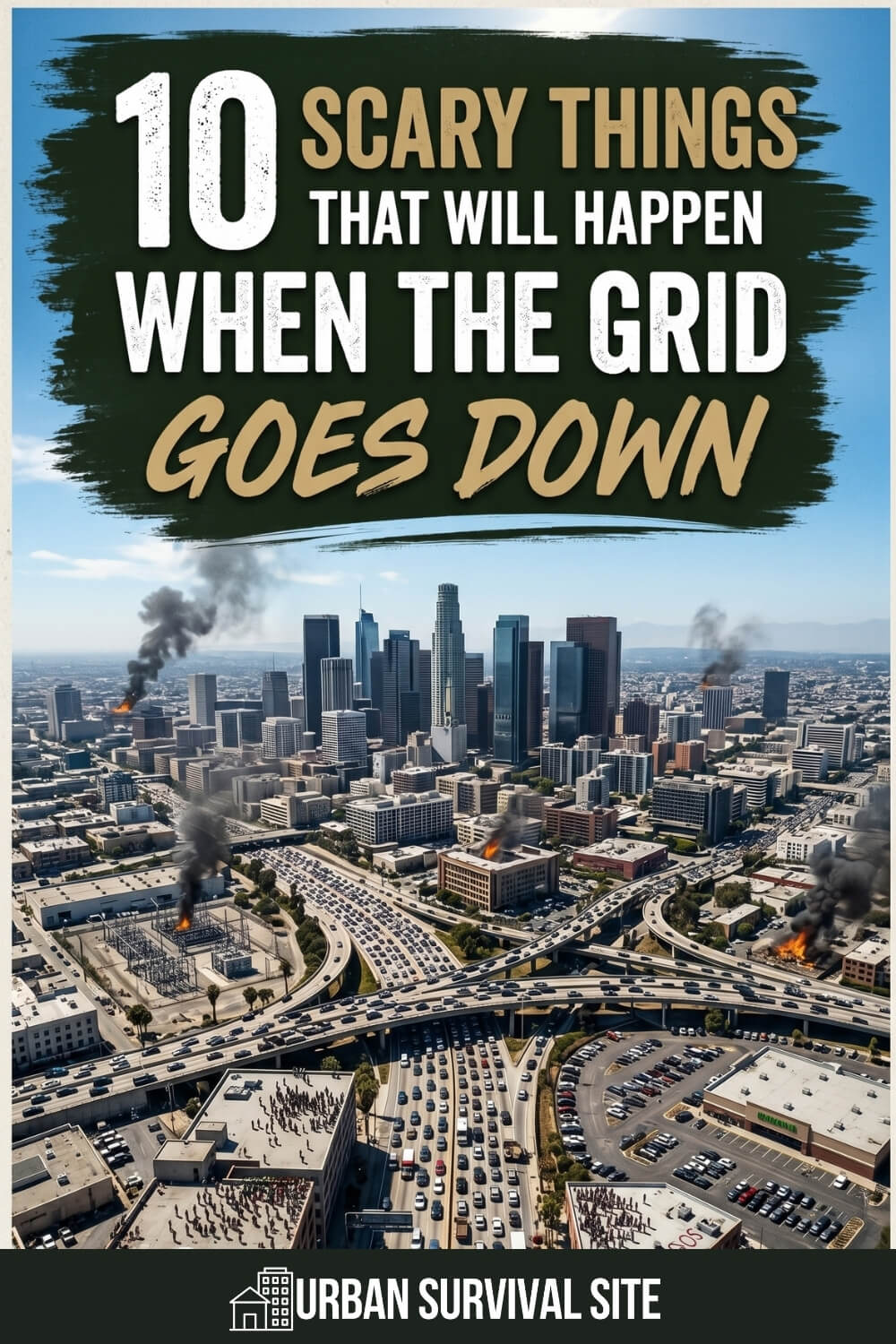
If and when the grid goes down, it’s not going to be like a normal power outage. Not even close. A true grid-down situation would last much longer, perhaps weeks or months, and during that time, a lot of things are going to happen that you never would have imagined.
Here are ten scary things that would happen if the grid went down. Hopefully, this will remind you of how fragile our society actually is and inspire you to start preparing if you haven't already.
Want to save this post for later? Click Here to Pin It On Pinterest!
1. No More Supply Trucks
When the supply trucks stop, no stores and restaurants are going to get resupplied. It’s not that it matters much anyway, because those stores are going to be looted and then abandoned afterward anyway.
This will guarantee that within a few short hours of the grid going down, life will already change dramatically because you will no longer be able to resupply yourself with the things that you need. Suddenly, you’ll be wondering why you hadn’t stocked up like you knew you should have been doing all along.
What most people don't realize is just how little food is actually sitting in their local grocery store at any given moment. Modern stores operate on what's called “just-in-time” inventory, meaning they only keep enough stock on hand to last a few days and count on a steady stream of deliveries to keep the shelves full. There's no big warehouse in the back loaded with months of supplies.
And it's not just groceries. Pharmacies, hospitals, and gas stations all depend on the same trucks. If you or someone in your family relies on prescription medication, you're going to want to talk to your doctor about keeping a little extra on hand, because once the pharmacy runs out, it's not getting any more.
If you haven't already, consider reading our beginner's guide to emergency food storage.
2. All The Stores Would Close
As was just mentioned, without the resupply trucks, stores and restaurants are most certainly going to be shut down. The only real question is, when will looting occur?
In some places, you can fully expect looting and rioting to occur within just a few hours of the grid going down, and perhaps even sooner than that. People are going to freak out, and everyone will recognize that it may be their last chance to get resupplied.
Once some people start looting, many more will join in just for the heck of it, and that’s not an exaggeration. Mobs and looters and raiding parties will form quickly and the general breakdown of society around you will be rapid. One moment things will be as they always were, and in the next everything will be a war zone.
If this happens, you'll need to avoid the riots and get home fast.

3. Schools Would Be Shut Down
Schools will be shut down, even though you can also guarantee they will hold onto any students in session during the early stages of the grid down situation. It’s incredibly unlikely that school administrators and educators will simply release children into the chaos, making it the responsibility of the parents to show up and retrieve their kids in schools.
This is where things could get really stressful for parents. With cell service down (more on that in a bit), you won't be able to call the school or text your kids to find out what's going on. And if you work across town, the roads could already be jammed with thousands of other parents trying to do the exact same thing you are.
That's why it's so important to have a plan worked out ahead of time. Find out what your kids' school does in an emergency, including where students will be taken if they have to evacuate the building. Decide in advance who's picking up the kids if you can't get there, and make sure the school has that person listed as an approved contact. It's also a good idea to pick a meeting spot that everyone in the family knows about, just in case you get separated and can't reach each other.
If your kids are old enough to walk home on their own, make sure they know at least two different routes, and talk to them about what to do if they run into trouble along the way.
4. Commerce Would Cease
This is one that you’re going to want to think about. A grid down situation is seriously going to lead to a complete and utter breakdown of commerce as we know it. Banks will no longer be open, ATM’s won’t work, and debit and credit cards will no longer be of any use.
Will you still be able to use cash? Possibly. At the very least, you'll be able to use it in the early hours of the disaster before things get really bad. You can head on down to your local store and buy as much stuff as you can get if you know things are about to head south.
Beyond that though, it’s difficult seeing cash being of much use for anything. The reason is simple: it has no value other than what people attach to it, and it’s not something we can use to stay alive. In the event of hyperinflation, where the individual dollar will lose value rapidly, it will be of literally no use at all other than as an alternative to Kleenex or toilet paper.
The only type of real commerce that will be going on after then will be bartering, or where people exchange certain goods that we need to survive for other goods. For example, you may be able to trade a box of ammo for several rolls of toilet paper (both of those things are going to be in very high demand following a major disaster).
5. Gasoline Would Be Gone
This is a big one. Gasoline is going to become one of the most precious commodities once people are unable to get any more of it at gas stations.
Everything from cars to motorcycles to ATVs to generators all run on gasoline. We’ve all seen post-apocalyptic movies and TV shows where literally thousands of cars are lying uselessly abandoned by the side of the road. Well, that really won’t be all too far from reality.
In short, once the gasoline supply runs out, we’ll lose everything that runs on gasoline. The gas stations might actually still have fuel sitting in their underground tanks, but it won't matter. The pumps that bring that gas up to your car run on electricity. No power means no pumping, unless the station happens to have a backup generator (and very few do).
Also keep in mind that gasoline doesn't last forever. Untreated gas can start to break down within a few months, which can gum up your engine or generator. If you're storing fuel, add a fuel stabilizer and rotate your supply regularly so you're never stuck with a can of bad gas when you need it most.
The only gasoline we’ll have left is what you have stored and what you will be able to barter from other people (and you can guarantee that it’s going to command a very high price).

6. Cell Service Would Stop
Now, cell service won't necessarily die the second the power goes out. Most cell towers have backup batteries, and some have generators, so you may still get a signal for a few hours or even a few days. But those backups won't last forever, and in the meantime, the network is going to be absolutely flooded with people trying to call their loved ones all at once.
If you do have service, try sending a text instead of making a call. Text messages take up far less bandwidth and will often go through when calls won't. And be sure to conserve your battery by turning down the screen brightness and closing any apps you don't need. A solar charger or a few fully charged power banks can make a big difference here.
Your phone may still work after a grid down, but it’s honestly not going to do you much good if you aren’t able to use it to access cell service or the internet. It’s one reason why investing in other communication devices will be so important, such as a HAM radio or a CB radio.
Once the Internet and cell service goes down, communication, as we know it in general, is going to get very different (and not at all easier).
7. Post Offices Would Close
You can say goodbye to ordering products from Amazon or sending or receiving mail from people when the grid goes down. This will greatly impact the way that we communicate with people long distance as well.
But it goes beyond Amazon packages. Think about all the things that normally show up in your mailbox: prescriptions filled by mail-order pharmacies, government checks, bills, and important documents. All of that will stop.
This is why it's a good idea to keep hard copies of your important documents (birth certificates, insurance policies, deeds, medical records, etc.) in a waterproof and fireproof container at home. If everything you need is stored in an email inbox or on a website somewhere, you won't be able to get to it when the grid goes down
8. Air Conditioning Won't Work
Is a lack of air conditioning life-threatening by any means? It depends. In the middle of summer, it very well could be if you don't take steps to keep yourself cool without AC. At the very least it will be very uncomfortable.
Heat is actually one of the deadliest weather hazards out there, and it tends to sneak up on people. During the Chicago heat wave of 1995, hundreds of people died, many of them elderly folks alone in apartments with no air conditioning and the windows shut. And that was with the grid still up and emergency services still running.
In a grid-down situation, the people most at risk will be the elderly, young children, anyone with a health condition, and pets. If you live in an apartment on an upper floor or in a home with poor insulation, things can get dangerously hot indoors, sometimes even hotter than it is outside. And don't forget that without power, your ceiling fans and box fans won't be running either.
This is why you need to know the warning signs of heat-related illness. Heat exhaustion usually comes first, with symptoms like heavy sweating, dizziness, headache, nausea, and muscle cramps. If you or someone else starts feeling this way, get to the coolest spot you can, drink water, and rest. If it's not dealt with, it can turn into heat stroke, which is a true medical emergency. Watch for confusion, slurred speech, hot skin, or a person who has stopped sweating. With no ambulance on the way, you'll need to cool them down fast with cool water and wet cloths on the neck, armpits, and groin.
A few simple things can go a long way toward keeping you cool. Keep your blinds and curtains closed during the day to block out the sun, then open windows at night when the air is cooler. Hang out in the lowest level of your home, since heat rises. Do any hard work early in the morning or in the evening, and drink water throughout the day even if you don't feel thirsty. A few battery-powered fans (and plenty of spare batteries) are also a cheap and smart addition to your preps.
One more thing to keep in mind: if you open your windows, you're also opening your home up to bugs. Mosquitoes can carry diseases, so it's worth stocking up on window screens, mosquito netting, and bug spray.
And it's not just air conditioning you won't have anymore…
9. Heaters Wouldn't Work
Just as the summer months are going to get really uncomfortable due to the lack of air conditioning, so will the freezing cold winter months due to the lack of heat.
In fact, the lack of heat is going to be a far worse problem than the lack of air conditioning and really could be life-threatening if it ever gets particularly cold outside.
This is why you’re going to want to stock up on as much firewood, propane bottles for heaters, and candles as you can. The firewood will be good if you have a firewood stove inside your home, but even if you lack the stove, you can still use it for getting a small and controllable fire outside.
Meanwhile, propane-run heaters will also be good to stock up on and cost less than five dollars each on average, and you can even use candles for warmth and light as well. Finally, be sure to invest in plenty of warm blankets and sleeping bags to go with it.
One very important word of warning: be extremely careful about what you burn indoors. Every year, people die from carbon monoxide poisoning after a power outage because they tried to heat their home with a grill, a camp stove, or a generator running in the garage. Carbon monoxide is colorless and odorless, so you won't even know it's building up until it's too late.
Only use heaters that are specifically rated for indoor use, keep a window cracked for ventilation, and never, ever run a generator inside your home or garage. You'll also want a battery-powered carbon monoxide detector (and plenty of spare batteries), since any detectors that are hardwired into your home's electrical system may stop working once their backup batteries die.
The same goes for candles. They're great for light and a little warmth, but they're also a leading cause of house fires, and the fire department may not be able to get to you in a grid-down situation. Never leave them unattended, and keep a fire extinguisher close by.
Here are some other ways to stay warm without a heater.
10. No More Running Water
You might still get some water out of your faucets for a little while after the power goes out. Many cities use water towers that rely on gravity to push water through the pipes. But once those towers drain, the electric pumps that refill them won't be running, and the water pressure will drop to nothing.
Without running water, your toilets won't flush either. In some areas, sewage treatment plants and pump stations will also fail, which can cause sewage to back up into homes. That's not just gross, it's a serious health hazard. It's a good idea to have a plan for handling human waste, such as a bucket toilet with heavy-duty trash bags and some kitty litter or sawdust.
As soon as the grid goes down, fill up your bathtubs, sinks, and any other containers you have while the water is still flowing. That water may not be safe to drink without treatment, but it'll be very useful for flushing toilets and cleaning. You won’t be able to run the dishwasher or the washing machine anymore, nor would you be able to take a shower, run the bath, water your plants, or even fill up a sink.
This is why when you stockpile water, you need to stockpile both drinking and cleaning/personal hygiene water. The recommended amount will be at least one gallon of water per person per day. One half of that gallon will be for drinking, and the other half will be for cleaning and personal hygiene.
Water filters and purification tablets will also be immensely important because when you do manage to procure more water for drinking purposes from other sources, it may not be safe to drink. Drinking unsafe water can oftentimes be more unsafe than not drinking any water at all, which will make a water filter device even more important and critical to own.
Here's a guide to collecting rainwater and some ways to purify water.
Like this post? Don't Forget to Pin It On Pinterest!
You May Also Like:




