

Estimated reading time: 6 minutes
Most people already own the gear that would get them through a blackout. A flashlight in a drawer, a radio on the shelf, a power bank buried in a bag somewhere, etc. But more often than not, those devices are at maybe 25 percent, or possibly dead, meaning they'll be useless when the power goes out. Owning useful equipment with a dead battery is one of the most common gaps in modern preparedness, and it's completely avoidable.
To avoid having dead devices during the next blackout or major disaster, you have to create a habit of recharging everything on a regular basis. You could market it on the calendar or put a reminder on your phone, whatever works for you. Just make sure everything is charged. And as for batteries, consider getting a battery tester to see how much juice is actually left.
The list in this post comes from the the UK preparedness channel, Charlie Survival, which focuses on calm, practical readiness without the fear-mongering. You can watch the video and see the complete list below. Here are 10 things you must keep charged.
Want to save this post for later? Click Here to Pin It On Pinterest!
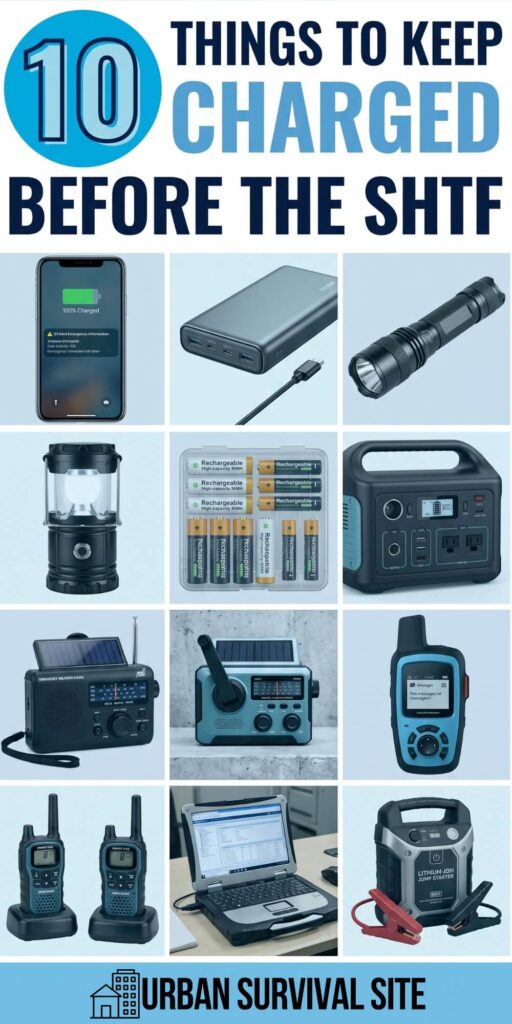
1. Your Phone
Number one is obvious, but most people use it completely wrong. The second a serious outage starts, stop treating your phone like entertainment and start treating it like emergency equipment.
That means setting it to lower power mode, lowering the screen brightness, and turning off Bluetooth if you don't use it. Stop endlessly refreshing social media, and skip the videos and games that drain the battery without helping you. Your phone can be your map, flashlight, banking access, weather source, news feed, and lifeline to family, but only for as long as the battery lasts.
It's also worth sending important messages early. Something simple works: “Power is out here. I'm safe. I'll update you later.” Mobile networks get congested fast during widespread disruption, so it's better to get that message out early than to wait until everyone else is trying at once.
2. Power Banks
This is the thing that keeps number one alive. Keep at least one good power bank charged, and ideally more than one.
The goal isn't to run your whole house off battery packs. It's redundancy. One power bank can fail. One cable can break. One battery gets left in another bag. And if the outage stretches into days, a decent power bank can be the difference between staying reachable and staring at a dead phone.
Larger capacity is nice if you use a lot of electronics, but the principle is the same at any size: keep them charged, test them, and know how many full phone charges you actually get out of each one before you need that number.
3. Lighting
Headlamps, handheld flashlights, and rechargeable lanterns all belong in the plan, but the headlamp deserves priority because it leaves both hands free. That matters when you're cooking, treating an injury, checking the breaker box, or moving through a dark house with something in your hands.
A rechargeable lantern is great for lighting a whole room, and a handheld flashlight is easy to hand off or point where you need it. But if you only prioritize one, make it the one you can strap to your head.
4. Portable Power Station
Not everyone needs to rush out and buy the biggest power station they can afford. But if you own one, keeping it charged makes a huge difference.
A power station can run lights, charge phones, keep communication gear going, and depending on its size, support some medical devices or refrigeration. The mistake people make is treating stored electricity like an unlimited resource. It isn't. If the power goes out, decide immediately what actually deserves a charge: communication first, then lighting, then medical needs, then information, then everything else. Don't burn through capacity running things simply because you can.
If you pair it with solar panels, learn before the emergency how long they realistically take to recharge the system in your actual local weather, not the ideal conditions on the box.
5. Emergency Radio
A battery-powered radio becomes surprisingly valuable when normal communication starts failing. Most people assume their phone will always deliver information, but that assumption breaks down fast. What happens when the internet is down, mobile data is overloaded, your router has no power, or your phone battery is nearly flat?
A radio gives you another way to receive information, and during a serious emergency, information itself becomes a resource. A hand-crank or battery model that you've tested and know works is one of the cheapest, most reliable layers you can add.
6. Satellite Communicator
This one isn't essential for everyone, but it's worth knowing about. A satellite communicator lets you send and receive messages in areas where normal mobile signal disappears entirely.
If you hike, camp, travel alone, or simply live somewhere rural where coverage is spotty, it can be genuinely valuable. The mistake is owning one and letting it sit flat. Before any trip, make sure it's charged, activated, set up, and familiar to you. Emergency equipment shouldn't require a tutorial once the emergency has already started.
7. Two-Way Radios or Walkie-Talkies
Owning walkie-talkies isn't the same as having a communication plan. Two flat radios in a cupboard aren't a system.
Used well, they're useful around a property, campsite, neighborhood, or between family members when cell networks fail. So if bad weather is forecast or disruption looks likely, charge them, keep them accessible, and test them in the actual spots where you expect to use them. Range on paper and range through the walls of your house are two very different things.
8. Rechargeable AA and AAA Batteries
This sounds less exciting than a power station, but rechargeable batteries are a quietly useful layer of redundancy. Flashlights, radios, headlamps, some medical devices, and plenty of small electronics still run on standard cells.
Keep a set of rechargeables charged and ready, and keep a sensible stock of ordinary disposable batteries as backup on top of that. This is where good preparedness gets less dramatic and more practical. You don't need one perfect solution. You need enough overlap that a single failure doesn't leave you with nothing.
9. Laptop or Tablet
During a longer outage, a laptop or tablet can help with communication, work, and access to anything you've saved locally. The key word there is saved.
Cloud storage is wonderful right up until you have no internet. So important documents, maps, instructions, contact details, and reference material shouldn't live only online. Store critical information locally on a charged device, and if you know a storm is coming, download anything useful before the network gets unreliable. Preparedness is largely about using the quiet period before disruption to make life easier afterward.
10. Portable Jump Starter
A flat starter battery can leave you stranded even when the vehicle itself is perfectly fine. A small lithium jump pack gives you a way out without needing a second vehicle and a set of cables on hand at the exact right moment.
Like everything else on this list, it only works if it's charged. A jump starter that's been sitting dead in the trunk for a year is just extra weight.
Like this post? Don't Forget to Pin It On Pinterest!
You May Also Like: